
Adapting in Real Time by Afrah
February 1, 2026
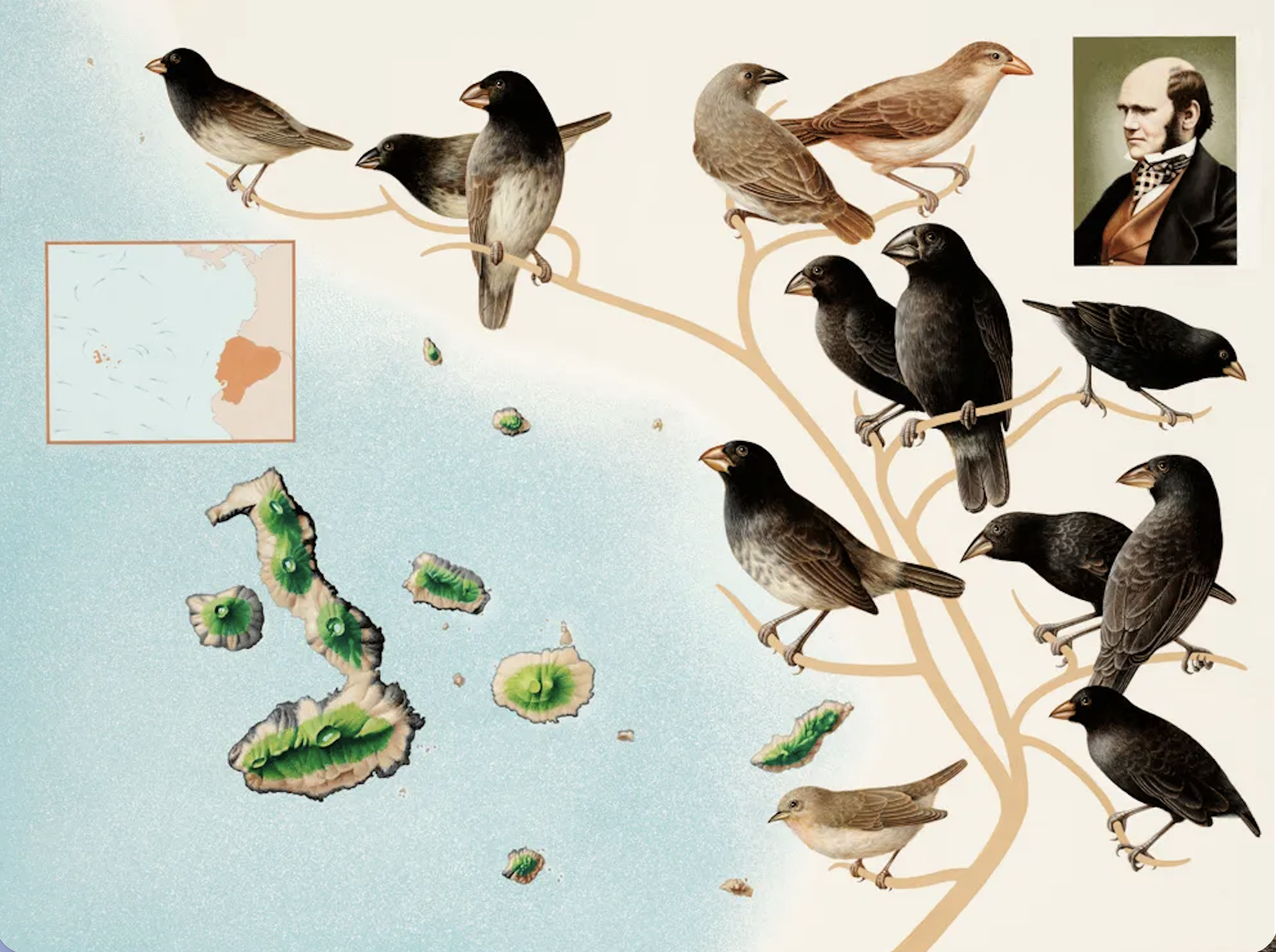
The Galapagos Islands: the first thought that comes to everyone’s mind when someone mentions 9th grade Biology. Darwin and his theory about the finches on this island are a close second.
9th grade was two years ago for me, but the Galapagos will always be engraved in my head.
Darwin’s theory shows how different species of finches were all derived from one ancestor. These birds transitioned from bland and ordinary to multi-colored, various-beaked, and starkly-vocalized finches.
This year—2026—is a transition from the dull, brown finches of ‘25 into finches with hints of yellow feathers and spotted bodies.
Adaptive radiation was Darwin’s reasoning for how these birds were surviving for so long on an island with specific conditions. It was a new term to me last year when I was surviving school, stranded without hope, feeling like nothing was going to change.
Looking back, it’s funny for someone whose life has changed so much since then.
This year adaptive radiation will be the defining feature of my life.
Change was fine tuned into evolution and adaptation: finding myself with a new food source fitting my needs without having to change my beak like Darwin’s finches. Even though this transition occurs in the time span of millions of years, we have the opportunity to metastasize into new situations.
New growth can be invasive, but it can also lead to advantages which offer survival. And survival for the fittest is for those who want it: want to survive, want to endure, and want to transition.
