
Painting a Survivor’s Story by Sahasra
March 23, 2026
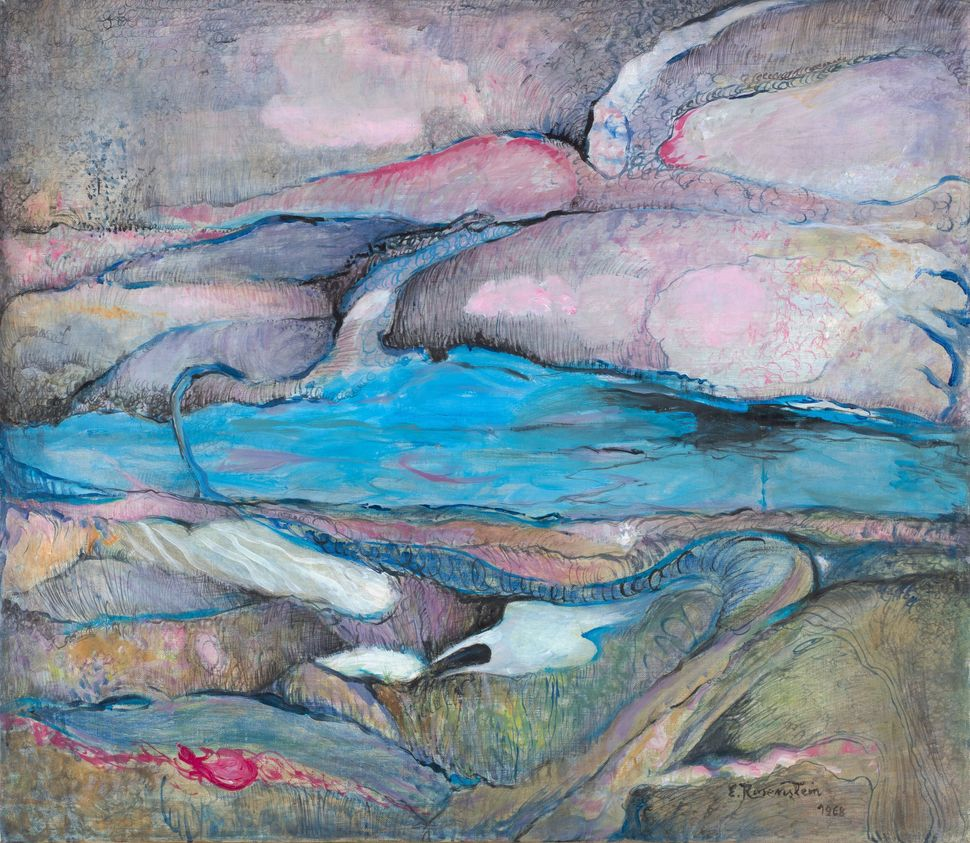
Although Erna Rosenstein is known in different parts of the world today, it wasn’t always that way. In fact, her first major international recognition came in 2021 when her work was displayed at the Hauser and Wirth gallery. Sadly, this achievement was awarded after her death, but she’s made many other great efforts throughout her lifetime.
Erna Rosenstein was born in Ukraine, and her family moved to Warsaw, Poland in 1918. They resided there until 1942 upon the approach of the holocaust.
For context, the holocaust was a period of Nazi terror towards people who didn’t fit Hitler, the then dictator’s ideals. He envisioned a perfect rule of the Aryan race. According to him, to preserve purity in Germanic blood, all Aryans were to have a standard of fair skin, blue eyes, and golden hair. People such as the disabled or Jews did not fit this stereotype.
So, the unwanted were subjected to murder. Or, they were sentenced to concentration camps–camps of forced labor and inhumane working conditions. Many did not survive concentration camps due to the lack of fuel, significant overworking, and disease which spread due to proximity. Additionally, some were killed within these concentration camps in toxic gas chambers. The innocent were pressed together and suffocated to their intoxicated deaths.
Even those who did survive these concentration camps were only surviving, not living. Many were described to have looked like skeletons due to intense starvation. Additionally, those who made it out often had nightmares. These horrid dreams were unshakeable, even after the passage of a few years.
Unfortunately for Erna, she was Jewish-born and worshipped the forbidden faith. Due to Nazi attacks, Erna and her parents sought a way to flee. During the escape, both of Erna’s parents were brutally murdered in a forest at the hands of Nazis. So, seeing that the circumstances were unsafe, Erna lived in the surrounding areas under different aliases. Erna finally moved back to Warsaw with her husband after the war.
She went on to continue her passion of painting, expanding views on the then untapped world of surrealism in Poland. She used paint to personify her firsthand experiences with strife and struggle.
Despite all of her sacrifice, she states, “Painting is something that is inherent in me, but at the same time, I can feel that some elements of the world flow through me and I only make them real.” And so, she demonstrates her humbleness; no matter how far she has come, attributes herself to the portal, not the object itself.
But, she is recognized by others too. For example, Alison Gingeras states, “In both her artistic and literary oeuvre, it is impossible to separate biography from her work.” From this, it can be known that Rosenstein’s art is an immersive experience; a dimension away from the ordinary.
Additionally, she has won several honors including the Jan Cybis Prize. She has also had her work displayed at the world renowned Metropolitan Museum of Art (MoMA).
Although some of Erna Rosenstein’s work would not have come if not for her past, that is not the only factor to her success. Her personal qualities are what allowed her to thrive and overcome the struggles that come with life. She was resilient through hardship, strategic in survival, and remained a visionary through it all.
Despite all of the challenges which Erna Rosenstein faced, she stuck with her passion. She even used it to empower others and reflect progressive views. She proves that setbacks are not complete halts and that no matter the issue, there is no excuse to not follow your dreams.
